Understanding PFAS in the construction industry

How prevalent are PFAS in the materials we build with, and what does that mean for the people who build, occupy, renovate, and demolish these buildings?
Contact

Martha Lewis
Head of Materials, Architect
Together with the Danish Technological Institute, WSP Denmark, Søren Jensen Consulting Engineers, and the Council for the Green Transition with support from Realdania and the Owners’ Investment Fund, we have published PFAS in Building Products: Challenges and Solutions on the Path Towards Circular Construction. The report maps how extensive the PFAS problem is across the construction industry, which building materials are most likely to contain PFAS, and what recommendations and solutions the sector can act on.

Hidden in plain sight
PFAS — the group of over 12,000 synthetic chemicals often called "forever chemicals" accumulate in humans and the environment and have been linked to serious health concerns, including increased risk of certain cancers, elevated cholesterol, hormonal disruption, and reduced vaccine efficacy in children. Once they enter the environment, they persist for long periods of time and have been detected in ecosystems, animals, and the human body. Some scientists argue that PFAS contamination has already breached planetary boundaries. Their unique properties — heat resistance, water and dirt repellency, extended product longevity — make them widely useful in industry and construction, but also extraordinarily difficult to remove once released.
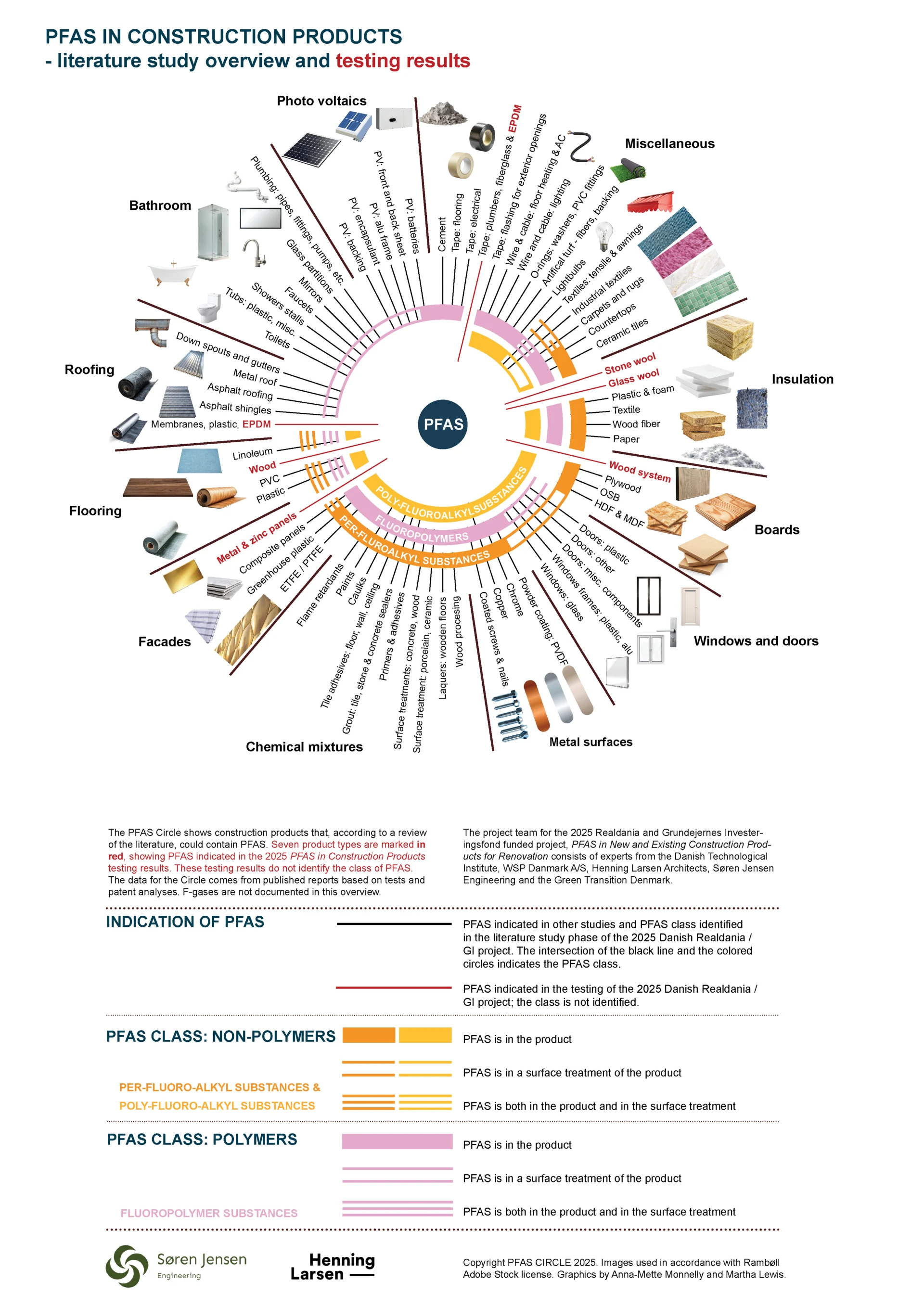
These substances are found across a remarkable range of building products. Insulation, flooring, facade cladding, roofing membranes, wall boards, tapes and sealings: our research suggests PFAS may be present in all of them and more. Yet this is rarely disclosed. Safety data sheets typically don't list PFAS content, since the vast majority of the substances are not yet registered in the European chemical regulation databases.
To understand the full scope of the problem, our project team reviewed existing international studies on PFAS in construction, assessed the consequences for human and environmental health across the entire building life cycle, examined the current regulatory landscape in Denmark and at EU level, and conducted new physical testing of building materials available on the Danish market.
The results confirmed that the existence of PFAs is not a theoretical concern for the construction industry. It is present in products being used in our buildings right now.
“The buildings we design today are the material banks of tomorrow. If we don't know what's in them, we can't safely reuse them and we risk locking harmful substances into the built environment for decades. That's the real urgency here: this isn't only a question of health, it's also a fundamental concern for circular construction."
Martha Lewis
Head of Materials, Architect
Long term consequences
During a building's operational life, PFAS may release into the indoor environment through the dust and air we encounter daily. Substances can also leach from roofs and facades under exposure to sun and rain, entering wastewater and aquatic ecosystems though knowledge of these risks remains limited.
When buildings are renovated or demolished, the question of how to handle PFAS-containing materials remains largely unresolved, both in terms of regulation and in practice. Reusing and recycling materials depends on knowing what those materials contain.
What can the industry do?
Regulation is moving in the right direction, but progress is uneven. While scrutiny of specific PFAS substances has increased over the years, the regulatory focus has historically centered on individual chemicals, and when one is restricted, others have simply taken its place. Today, regulation still only covers a small fraction of the approximately 12,000 PFAS substances in circulation. In part due to this challenge, the EU PFAS restriction proposes a wide ban on all types of PFAS. Introduced by Denmark and 4 other countries in 2023, the proposal is currently moving slowly through the EU and includes limit values for polymer PFAS and non-polymer specific PFAS substances for products in all sectors. The fate of the proposal is expected to be clear by the end of 2026.
The sector alone cannot phase PFAS out of the built environment, and political will and stronger regulatory frameworks are essential. But there is meaningful action available today, without waiting for legislation to catch up. Suppliers should be asked to provide product declarations and documentation of chemical content. Where alternatives exist, PFAS-free products should be actively prioritized. Performance properties like water repellency or extra durability should be treated as a prompt to ask harder questions about what is in a product. And knowledge about material content should be recorded in digital passports from the outset, so that information about what is and is not known stays with a resource throughout its entire life cycle.
The full report sets out a comprehensive set of recommendations for everyone in the value chain, including clients, consultants, contractors, and manufacturers, along with the full findings, and reflections on how the sector can move forward. Find the full report below.
Downloads
PFAs in building products
Guide, English